Reflections · May 4, 2026
On Dr. William Bridges, the neutral zone, and what it means to walk a transition on purpose.
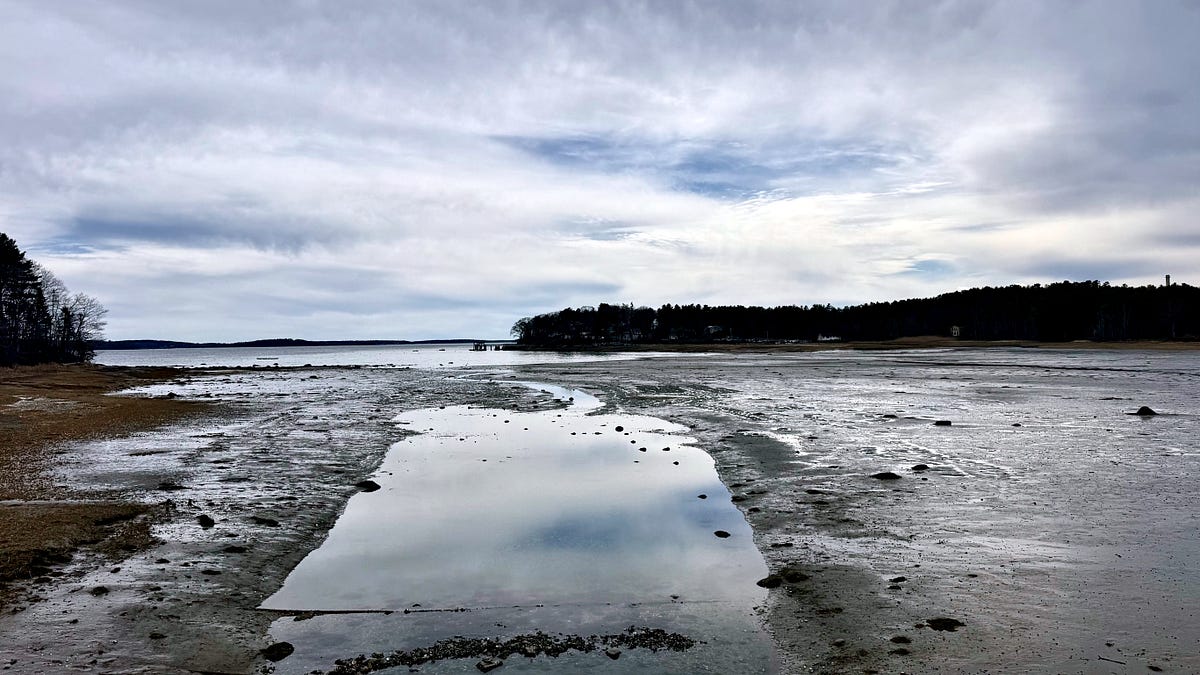
The causeway between Littlejohn and Cousins at low tide, under clearing clouds: a fitting image for the neutral zone, when what has ended and what comes next are both still in view, and the path forward appears slowly.
The float is now back in place at the Littlejohn Island dock. The past few nights, we paused to take in the full Flower Moon shining over the Chebeague Island crossing. Yesterday, my husband and I ran by bursts of forsythia brightening the rain-greyed landscape.
Even though we often still wear gloves and multiple layers when we go outside, the seasonal markers say spring is here: forsythia along the roadway, the float at the Littlejohn dock, and the full Flower Moon over the Chebeague Island crossing.
I wrote in A Waypoint With No Name about a blocked trail on Cousins Island, a house that had burned quietly, and the kind of changes that do not always announce themselves, including those that are ambiguous or complicated. The path continues.
There is a waypoint past the naming. Once we acknowledge a change, the question becomes what to do with it.
We may not feel a sense of greater ease or get back what we've lost, but when we pause to notice what has ended and what remains, we can begin again on more solid ground.
Thirty years ago, just as I was beginning my first year of family medicine residency training, my grandfather died. My father, also a family doctor, had been close to my Pepere, and this death hit him hard.
Soon after that, a major fire badly damaged my parents' house. They moved with my brothers and sisters to a temporary home in a nearby town.
These changes challenged my parents and siblings, and they challenged me, too. At the time, medical residency meant working extremely long weeks routinely, often with little sleep. In 2003, the Accreditation Council for Graduate Medical Education began limiting clinical and educational work hours to 80 hours per week. I finished my education before that occurred. When I started family medicine residency, I had an infant and a toddler. I was more tired than I had ever been.
Fast forward to December that year, and my parents were still in the temporary home.
We celebrated Christmas from a place of transition. I can still feel the strangeness of celebrating that holiday, with everything around us rearranged. We no longer had the grandfather who had been with us for many celebrations. We were not in the house where my siblings and I had grown up. The children still needed meals and mittens. I still needed to report to the hospital. My parents still had to make decisions about contractors, insurance, belongings, and where everyone would sleep. Life did not pause simply because we had lost a family member and the house had burned.
At the time, this all felt hard in the way death and emergencies feel hard. Now, after many more years of raising children, keeping homes, and watching lives change in ways none of us can fully control, I can feel the disruption even more deeply.
The house was still structurally intact. Smoke, water, heat, and upheaval had damaged what the fire had not. Things in rooms untouched by flame still needed sorting, cleaning, discarding, or replacing. Some were gone for good.
My parents rebuilt their home within a year and began work on the new version of their family.
I understand all of this differently in hindsight. I now understand what it means to lose a father. I understand that a fire does not end when the flames are out.
Similarly, a transition does not end when someone announces it, whether the announcement names a fire, a death, or a professional restructuring.
Sometimes the hardest work begins after the visible crisis has passed.
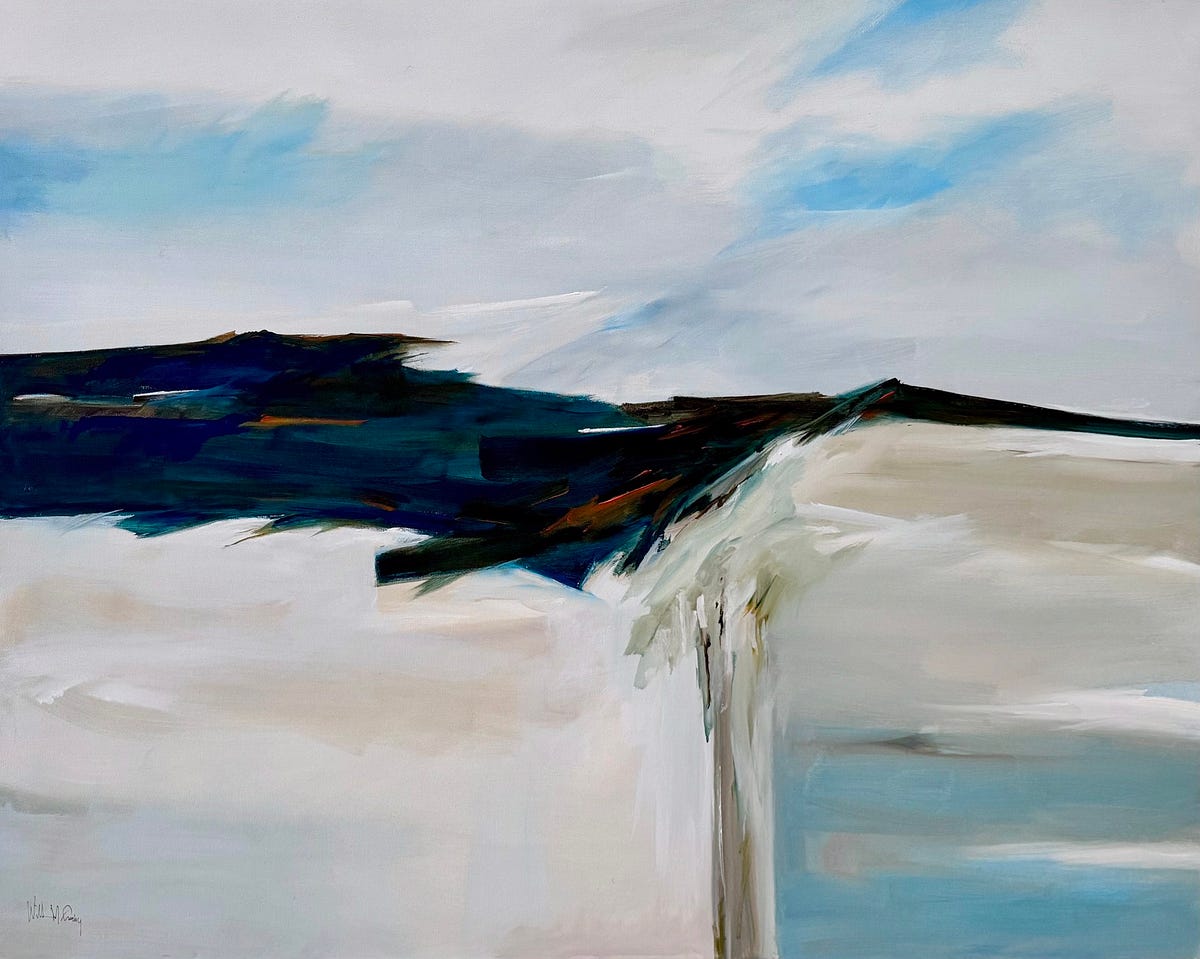
A fire does not end when the flames are out. A transition does not end when someone makes an announcement.
This is often how transition works.
Something ends. Something visible happens. The fire is over. The decision has been made. The role is gone. The person has died. The move has occurred.
Then comes the work after the ending.
I discussed Dr. William Bridges' research with my co-host, Dr. Jeff Barkin, for an A Healthy Conversation show on transitions. Bridges described transition not simply as change, but as a psychological process. There is an ending. Then there is a neutral zone. This is an in-between time where the old identity no longer fully fits, and the new one has not yet formed.
Only after that can a true new beginning emerge.
The neutral zone is not wasted time. It is the work.
This neutral zone has a place in organizational change. We previously talked about Dr. John Kotter's work on change. Kotter's eight well-known steps of change are: create urgency; build a guiding coalition; co-create a clear, shared vision; mobilize a volunteer network of champions; remove barriers so people can act; deliver and celebrate short-term wins; sustain momentum; and embed the change in the culture. These steps focus on structure and sequence.
Many people are also familiar with Dr. Bruce Tuckman's stages of group development: Forming, Storming, Norming, Performing, and Adjourning. These stages describe the life cycle of a group.
Bridges gave attention to something those frameworks often skip: the private work of letting go of a role before the next one forms. This is the quiet, internal work each team member does when a company reorganizes, a leader departs, or a mission changes.
The burned houses offer a visible image of an invisible process. Before people can rebuild a house, someone has to walk through what is still standing. Someone has to decide what is sound, what is unsafe, what can be carried forward, and what must be released.
Bridges wrote about the neutral zone for both individuals and leaders.
The leaders who handle change well, in the organizations I have worked with and written about, are the ones who give themselves and their teams room for the neutral zone. They do not confuse their own urgency to act with the team's readiness to begin. They let the ending be an ending. They name what was, and what is gone. Only then do they invite their people into what comes next.
One of the best leaders I have worked with once learned, after the fact, that the organization had restructured a position he had held for many years, without his knowledge. The biggest change was that he would no longer be eligible to hold that position. He could not leave for a similar role elsewhere; his work rooted him in a community to which he and his family belonged. Rather than dwell on what had ended, he stepped into a parallel leadership role within the educational arm of the same organization. The people he joined benefited from his willingness to move through what could have been a devastating change.
On A Healthy Conversation, my co-host, Dr. Jeff Barkin, and I talked about what it takes to lead people through ambiguous loss, not just logistical change. A reduction in force, a merger, a rebrand, or a retirement can each produce something close to what Pauline Boss and Kenneth Doka describe: the ambiguous loss and disenfranchised grief we named in A Waypoint With No Name. Leaders who recognize that and make room for the interior work tend to build the kinds of organizations people stay in voluntarily.
This does not mean leaders need to make every transition soft or endlessly process every decision. It means they understand that people do not move from one identity to another by memo alone. They need context. They need honest language. They need a chance to orient themselves before anyone asks them to perform certainty they do not yet feel.
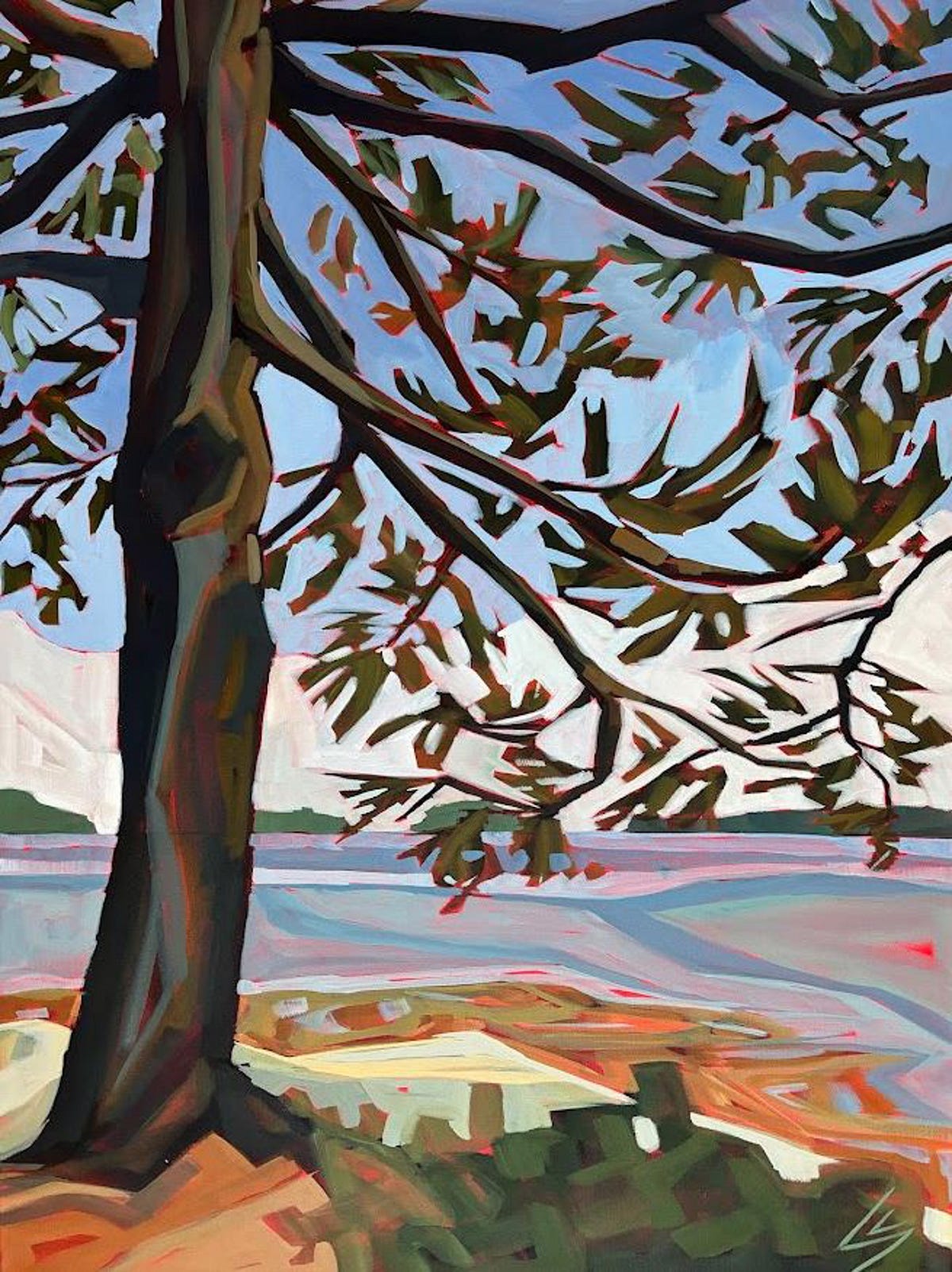
This neutral zone can be deeply uncomfortable, especially for those of us who prefer motion to standing still.
I know this tendency in myself. After an ending, I have often wanted to leap straight into the next beginning. I have wanted to use the tools that worked before to rebuild quickly and prove I was still moving.
Rebuilding too fast can mean building on an unsafe foundation.
A burned structure needs clearing. The bones need inspection. We have to separate what is salvageable from what is not. This takes time, discernment, and the courage not to confuse motion with healing.
Or, perhaps more precisely, not to confuse motion with rebuilding. Healing may happen beneath the surface, but rebuilding requires attention. Rebuilding asks us to look closely at the foundation before we raise walls.
What most of us underestimate is how much strength this interior work builds. The people I know who have come through the hardest transitions are not the ones who moved fastest. They are the ones who moved attentively.
They are the ones who allowed the neutral zone to teach them.
Rebuilding asks us to look closely at the foundation before we start raising walls.
Spring is an appropriate season for this kind of reflection. Grass grows around the winter's damage. Dandelions emerge in the most unexpected places. On the Cousins Island property I ran past, the shed still stands. The trees are budding. Something remains.
Something else has irrevocably changed.
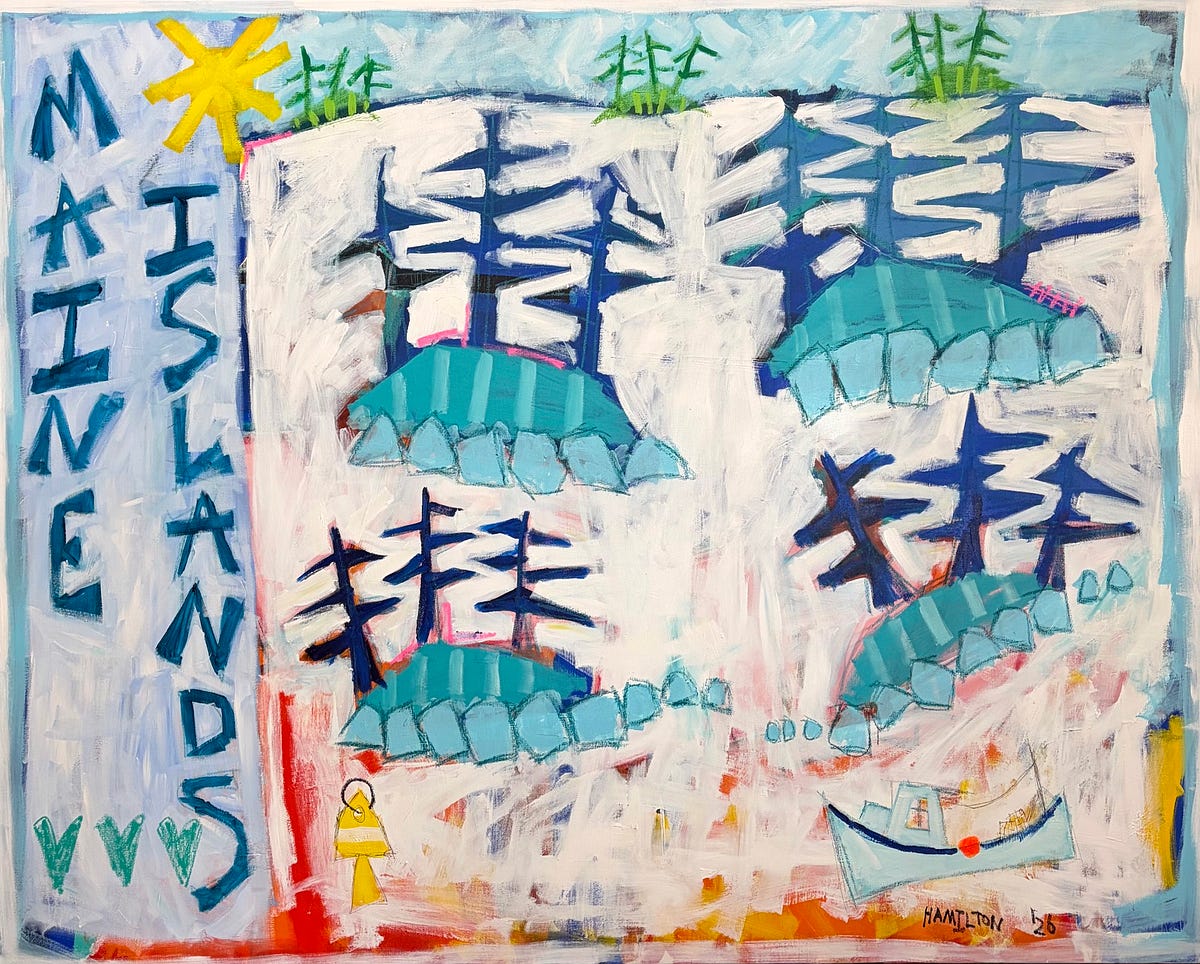
Many of us are living inside transitions of this kind right now. Some are personal, some professional, some cultural and collective. In recent years, many people across healthcare, technology, government, and other industries have experienced job transitions, reductions in force, or the loss of daily ties to colleagues who continue without them.
There is no single fire, no clear marker, no obvious endpoint. The organization remains, but your place in it has changed. The people remain, but the daily rhythm is gone. You may feel grateful, relieved, displaced, hopeful, and sad all at once.
For me, this has sat atop broader changes from the COVID years, the death of my father, and the ongoing work of building The Bountiful Path. The companion essay was about naming the changes that do not announce themselves. This one says: the path reroutes, and it can still be bountiful.
Not bountiful because nothing hurt. Not bountiful because everything returns as it was. Bountiful because life keeps offering material for repair: a shed still standing, grass returning, a float waiting to hold a summer's worth of dinghies, or a path that asks us to choose another way.
I wrote the companion essay and this one with particular people in mind, colleagues, friends, readers, and patients who have been quietly walking through their own transitions.
On the companion essay, Jenn commented:
Thank you for so many things to ponder in this piece. Transitions and change can bring grief and fear, even if they are welcome changes. I thought about the burned-out house that you describe, and how unnerving that can be, even if no one was living there at the time. In Bath, there have been three very old, classic buildings that recently have been razed on Washington St. I can't help but wonder about the history of those spaces and the people who inhabited them.
We're living in times of tremendous change, and it often feels like it takes a lot of effort to stay balanced amid all the upheaval. Jenn's comment reminds me that people have lived through change before. It's helpful to have company on the journey.
Ultimately, change is good. Growth is good. A life that keeps moving through new seasons is the life most of us want. At the same time, being inside the movement is not always comfortable.
Three practices for the neutral zone: pause long enough for the next step to become clear. Name what has ended, even to yourself. Ask one person to sit with you in it. These are not complicated. They are what we most often forget.
Perhaps one more: notice what remains.
If you are a leader, the invitation is the same. The work you do in your own neutral zone is also the work that teaches you how to lead your people through theirs.
Pause + Reflect: What part of your current transition might be asking for the neutral zone rather than the next step?
Back on Cousins Island, the float now waits for summer visitors. The forsythia brightens the roadway. The shed on the burned property still stands. The temporary stoplight on Cousins Island still asks us to pause before moving forward.
Sometimes that pause is the practice.
Sometimes the pause is what makes return possible.
May we trust that changing direction is not always leaving the path. Sometimes it is how the path continues.